
Public access to Georgia arrest records
The Georgia Open Records Act gives the public a right to request records that agencies already hold, though exemptions apply. A booking display, a police report, a docket, and a private web page can disagree on facts and timing.
Two statutes shape what you actually see. O.C.G.A. § 35-1-19 restricts when an agency posts or releases booking photos. O.C.G.A. § 10-1-393.5 forces covered commercial sites to remove a photo free of charge when a listed condition applies. Neither one erases every copy out there.
A booking entry marks an arrest, not a case result. The court record alone states how the case ended, and charges can shift or drop along the way.
Two statewide routes help. The Georgia recent-arrests hub covers county rosters and the booking-photo landscape, while the Georgia County Directory points to the local custodian once you know where the booking happened.
What Georgia’s Open Records Act provides
O.C.G.A. §§ 50-18-70 through 50-18-77 open the door. These provisions make existing agency records available unless an exception applies. The custodian is whoever holds the file. That is typically the arresting agency, sheriff, jail, prosecutor, or court. Send your request there. No statewide office keeps every local arrest record.
A request can be oral or written, but writing preserves its scope and date. A custodian generally gets three business days to release accessible records or explain an exemption, added time, or estimated cost. Fees follow the lowest-paid qualified employee, with the first 15 minutes generally free. Copies may run up to 25 cents per page plus allowed media or delivery charges. Always check the agency's current schedule.
Ask for an existing report or booking record over a defined date range. The Attorney General's Open Records request guide walks through the process. No agency must build a statewide arrest index. It also need not certify a case result.
- Choose the office that holds the record.
- Name the record, date range, and known incident detail.
- Ask for an existing record, not a new database.
- Review any redaction, exemption, time, or fee estimate.
What Georgia police records may be withheld
The pending-investigation exception in § 50-18-72(a)(4) is narrower than agencies sometimes claim. It does not cover everything. The Attorney General's law-enforcement guide is clear. An initial arrest or incident report stays open even while an investigation continues. Other statutes still shield juvenile material, informants, medical details, and private identifiers. A custodian should cite the specific exception for anything withheld. Whatever can be separated should be released. Remember that report access does not override the separate booking-photo limits in § 35-1-19. A redaction never proves a record fails to exist.
What Georgia’s booking-photo law limits
O.C.G.A. § 35-1-19 defines a booking photograph as an image an arrest agency takes or uses for identification during jail processing. The statute generally bars an arresting agency or its agent from posting that photo online. Exceptions exist for § 50-18-77 disclosures, publication required by Titles 16 or 40, the state sex-offender registry, and law-enforcement use. This binds agencies. It is not a ban on every mugshot online.
Copy requests face a second hurdle. An agency may refuse a copy when it knows or reasonably believes the requester plans to send it to a publication charging for removal. Requesters must submit a statement of lawful intended use. A knowingly false statement can violate § 16-10-20. HB 845 built this framework, effective July 1, 2014. Arrest reports can stay public even where photo release is limited.
What Georgia’s booking-photo proposals changed
Later bills aimed wider, but neither became law. The 2024 House composite lists HB 882 as withdrawn and recommitted. The 2025-26 House composite matches. It shows the same fate for HB 10, the Georgia Booking Photo Privacy Protection Act, per the 2025-26 House composite. So § 35-1-19 still controls.
A February 2026 Axios report covered a Fulton County lawsuit over a Georgia Gazette listing and an anti-SLAPP motion tied to a law protecting speech on public issues. The story reports competing claims and requests. No final ruling or injunction has landed. Enacted law still starts with HB 845, not a lawsuit or a withdrawn bill.
Note: The General Assembly's composite records show bill activity; they do not change the code unless a measure completes enactment.
When juvenile and protected arrest records stay closed
Juvenile records get far stronger protection. O.C.G.A. § 15-11-708 keeps juvenile court records and law-enforcement files about children confidential, with narrow openings for a transferred criminal case, national security, a lawful public hearing, or a court order serving the child's best interests. The Attorney General's juvenile-record guidance explains these limits.
Never infer adulthood from a commercial page. Do not repeat an apparent juvenile name or photo. Ask the custodian or the court instead. Agencies may also redact private identifiers, medical facts, victims' identities, or confidential-source details. A public roster is not a certified criminal-history record.
How Georgia record restriction works
Georgia calls it record restriction. It limits public access to certain criminal-history data. The process is not a full erasure. Courts and criminal-justice agencies can still reach the information, and a court docket, jail system, or private copy may lag behind. Eligibility turns on the charge and its final disposition, not merely on how long ago the arrest happened.
The arrest date matters more than you might think. Georgia.gov and the Georgia Courts self-help materials lay out separate routes for arrests before July 1, 2013 and after. No single application fits every case, so follow the state's current directions for the right form or prosecutor contact. GCIC stands for Georgia Crime Information Center.
The Georgia.gov restriction guide shows the current date-based route. Its screenshot ties the process to timing and disposition.
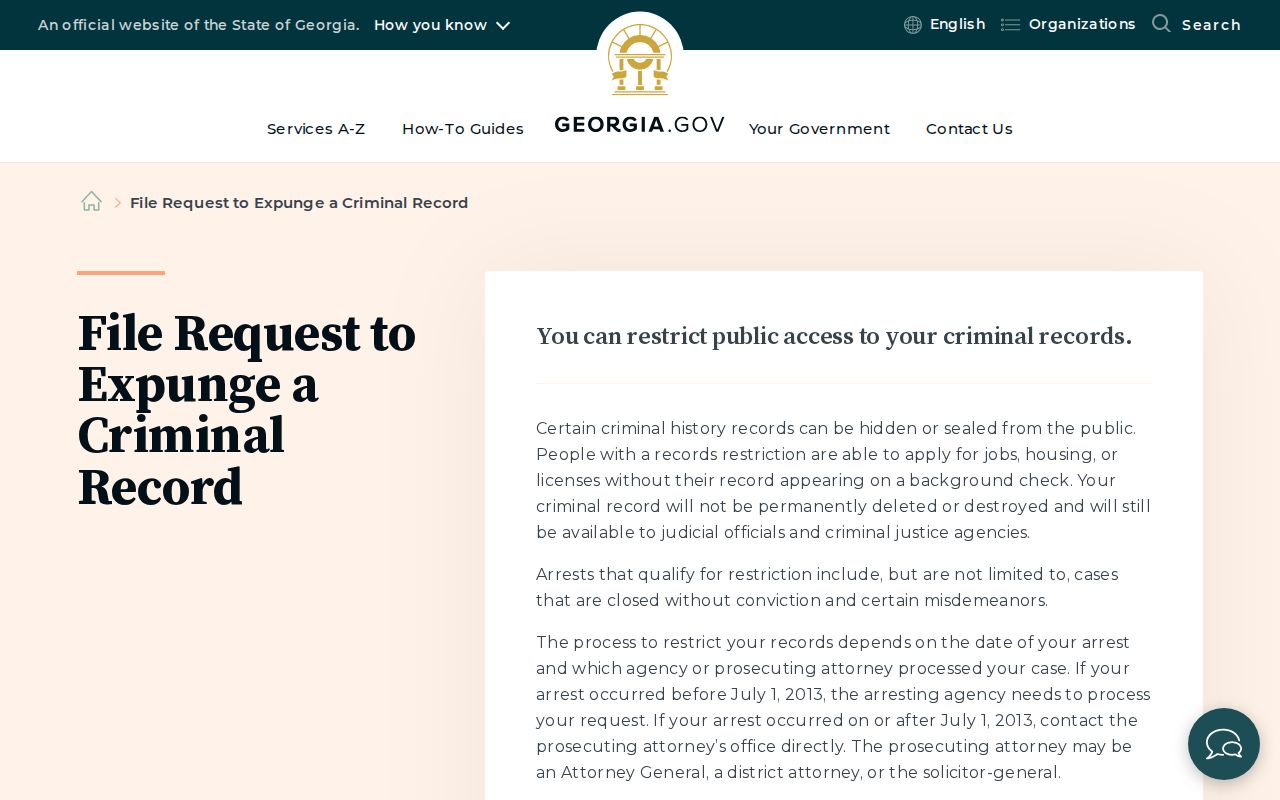
Always follow the live state instructions. The right form or prosecutor contact depends on the arrest date, and one route will not fit every case.
| Arrest date | Starting route described by Georgia | What follows |
|---|---|---|
| Before July 1, 2013 | Contact the arresting agency for the older restriction form. | The agency and prosecutor review it, then an approved request proceeds to GCIC. Check Georgia.gov for current fees and instructions. |
| On or after July 1, 2013 | Contact the prosecutor’s office that handled the case. | The official guide describes a 90-day decision period, a 30-day Superior Court appeal period after denial, and GCIC processing after approval. |
Which Georgia dispositions may qualify for restriction
Disposition simply means the court-recorded outcome. GBI lists results that can support restriction. Examples include dismissal, no further action, nolle prosequi, dead docket, or no record on file. A dead-docket case stays pending rather than dismissed. Conditional discharge and first-offender outcomes follow separate statutory steps, and a qualifying judge's order can direct a court, jail, or law-enforcement agency to restrict records. The GBI criminal-history FAQ explains how disposition, restriction, and retained records relate. Private pages do not always follow suit.
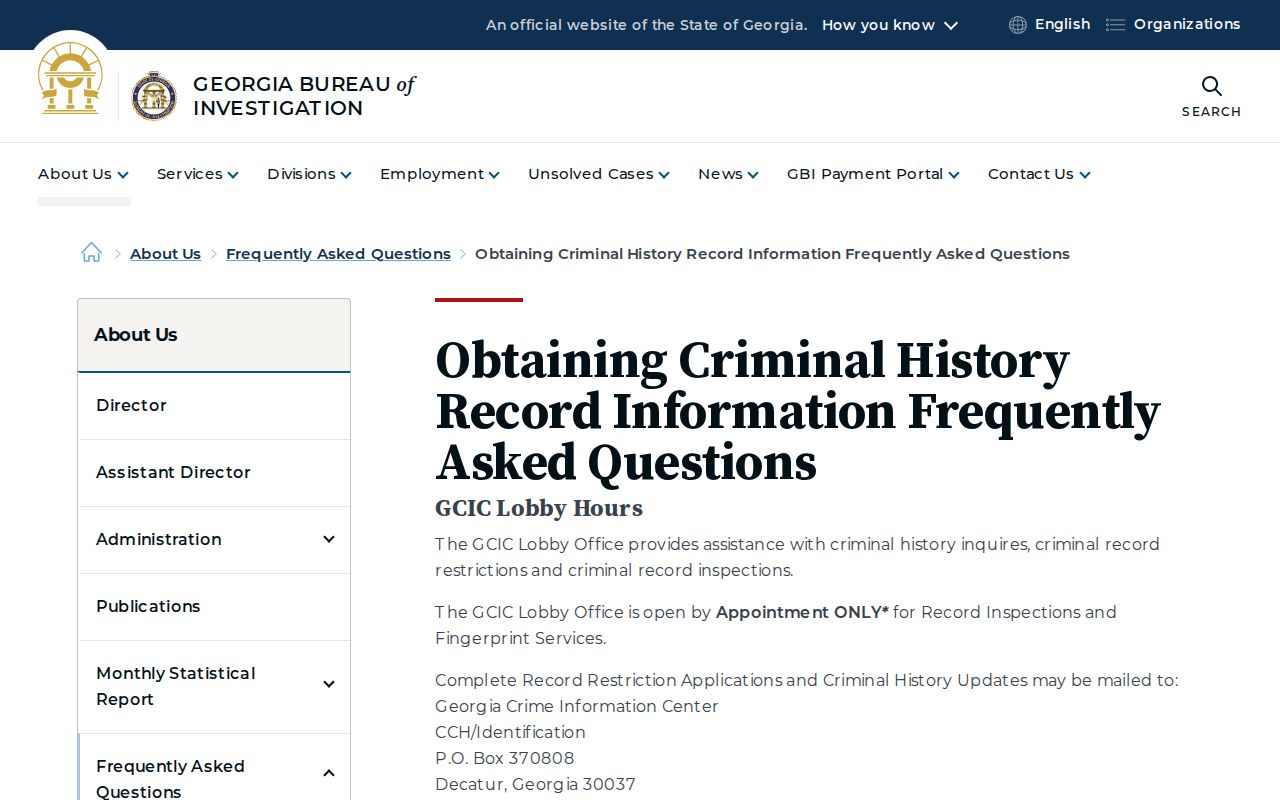
For current forms, fees, mailing steps, and timing, Georgia.gov is the live source. Disputed cases belong with a lawyer, prosecutor, or court. Never generalize a waiting period across all charges. A roster's disappearance does not prove a legal restriction was entered. Those are two different things. Note: Record restriction limits public access under the applicable process; it does not turn an arrest into a different court disposition.
When Georgia requires free mugshot removal
O.C.G.A. § 10-1-393.5 works differently. It is a commercial-publication rule, not part of restriction. It gives a qualifying person the right to request free removal of a booking photo from a covered website. Georgia's Attorney General lists eight qualifying situations. Each turns on the case's procedural result. Match the actual court or agency record to the statute before sending anything. The Attorney General's plain-language mugshot guidance summarizes the eight triggers and the written request route, and its screenshot is official state guidance rather than a commercial booking page.
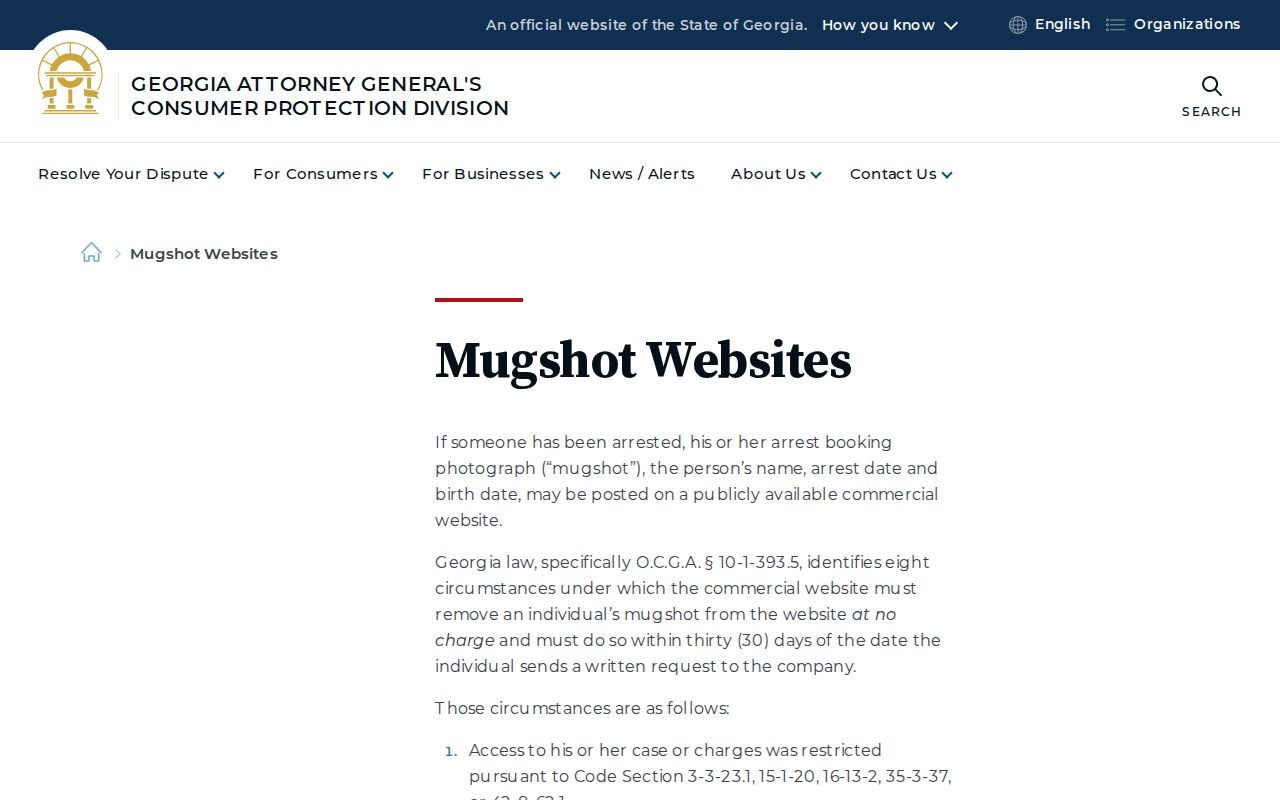
The free route requires a listed case result and a written request. It is not a general eraser for every public source. The AG guidance also flags a news and commentary exception. The statute does not create a blanket takedown order. It does not reach every story or independent copy.
| No. | Qualifying condition described by the Attorney General |
|---|---|
| 1 | The case or charge was restricted under § 3-3-23.1, 15-1-20, 16-13-2, 35-3-37, or 42-8-62.1. |
| 2 | Before a charging instrument, the agency closed the case without referring it for further prosecution. |
| 3 | The statute of limitations expired before indictment, charge, or another charging instrument. |
| 4 | A prosecutor received the case before charges, then dismissed it. |
| 5 | A grand jury returned two no bills before the case was charged. |
| 6 | After indictment or charge, every charge was dismissed or nolle prossed. |
| 7 | The person pleaded guilty or was found guilty of a qualifying narcotic, marijuana, stimulant, depressant, or hallucinogenic drug-possession offense, received § 16-13-2 probation, and completed it successfully. |
| 8 | A judge or jury acquitted the person of every charge. |
Two terms come up often here. A nolle prosequi drops a charge. It is the prosecutor's formal decision to drop one. A no bill means the grand jury declined to indict. The written request must include the person's name, birth date, arrest date, and arresting agency. Send it by certified mail with return receipt or statutory overnight delivery. Address it to the publisher's registered agent, principal place of business, or primary residence. Removal must happen for free within 30 days. Charging for removal can violate Georgia's Fair Business Practices Act. Missing the deadline can too. The Attorney General's Consumer Protection Division takes complaints about noncompliance.
How free publisher policies differ from state law
Some secondary publishers write their own correction or removal rules. Those private policies can help with an outdated, wrong-person, dismissed, or restricted listing. They still are not law. They cannot replace a Georgia court order, change the official disposition, or bind another publisher. The official county or court record comes first.
RecentlyBooked posts one such policy. Its free route covers specified cases like dismissed, sealed, incorrect, outdated, wrong-person, juvenile, or duplicate material, provided the person sends the requested details and documents. The publisher writes the policy and can change it. Accurate, current public records generally stay posted outside the listed categories.
The screenshot comes from the RecentlyBooked correction and removal policy. It is secondary, not an official Georgia record. It also does not guarantee a request qualifies.
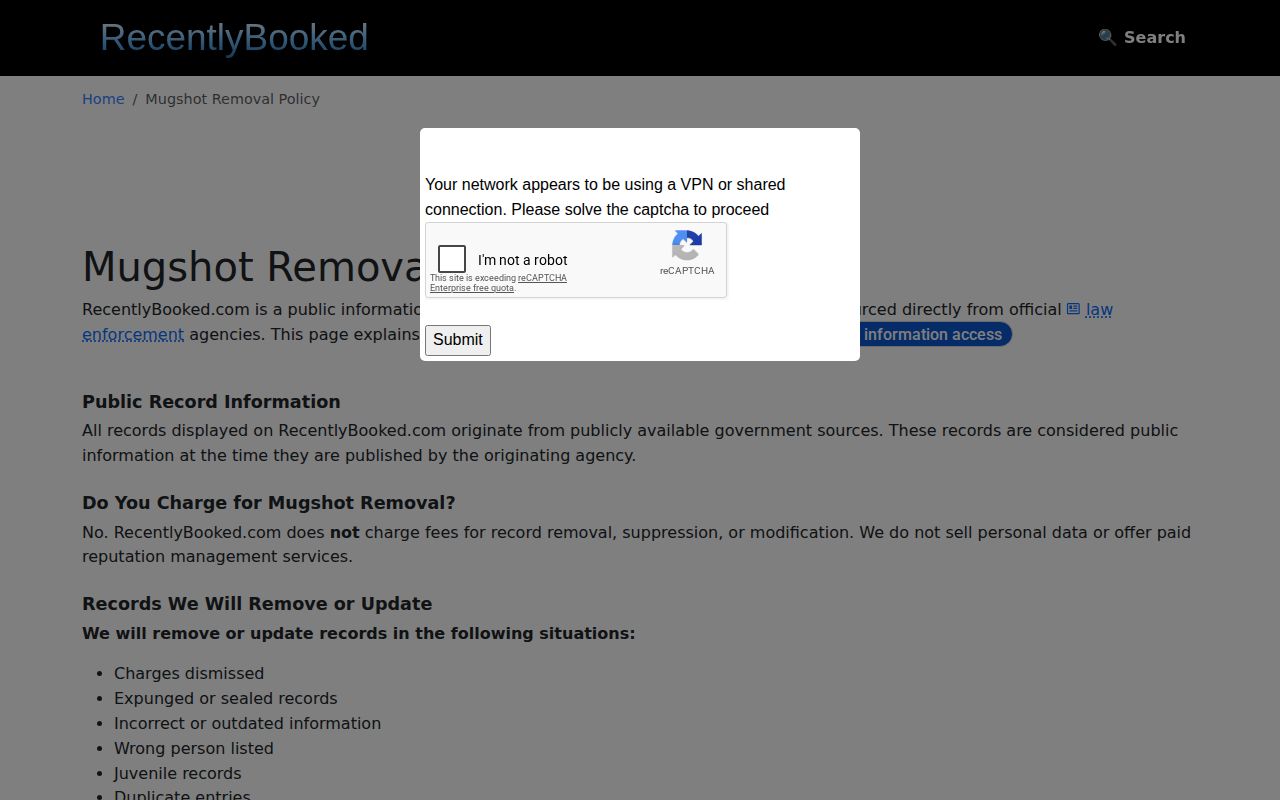
Pick the route that matches the problem. An official restriction request changes public access to qualifying state criminal-history data. A § 10-1-393.5 letter targets a commercial mugshot page. A publisher's own correction form simply asks that publisher to review its copy.
How Georgia arrest publishers handle corrections
Georgia arrest data travels well beyond official channels. Sites like Busted Newspaper, RecentlyBooked, Mugshots.com, Arrests.org, Mugshots.zone, and the Georgia Gazette republish booking records statewide. None of them adds up to a full official index. Each handles corrections differently. Busted Newspaper offers a free, document-based review for certain dismissed, sealed, or not-guilty cases. Mugshots.com says it will consider free updates when you document legal restrictions or a favorable outcome. RecentlyBooked posts free correction categories but takes the position that accurate public records stay up. The Gazette runs its own free Second Chance Policy and decides what qualifies. Mugshots.zone sketches a documentation route, though no stable Georgia page backs it up. Arrests.org gives record-level contacts, and that's it. There's no clear statewide free opt-out.
Newsrooms are a different animal. The Georgia Recorder, Atlanta Journal-Constitution, 11Alive, WSB-TV, FOX 5 Atlanta, WALB, WTOC, and 13WMAZ report stories. They don't run booking rosters. Their correction channels fix articles, not mugshots. Even a successful correction leaves official records untouched, and private copies plus search snippets can linger. Skip anyone selling total erasure.
Why Georgia roster entries disappear
A roster entry vanishing means less than people assume. Windows close, links break, vendors switch. None of that shows an agency destroyed its booking file. Display, legal access, and retention are three separate things entirely. A restriction can hide a record from the public. Courts and criminal-justice agencies keep their copies. Private pages or search snippets may persist anyway.
The Georgia Archives local-government schedule sets series-specific retention periods. LG-19-050 incarceration lists are kept one year. Inmate case files under LG-19-054 last ten years after release. LG-19-070 prisoner hold records run two years after release, going back to the requesting agency. Those clocks govern named record series, not a live roster page. Ask the county custodian whether a file sits in local hands, was transferred, is restricted, or was destroyed under an approved schedule. Court dockets and GBI criminal-history data live in separate systems.
Note: A missing roster result does not establish that no arrest occurred or that a legal restriction was entered.