
Georgia Arrest Reports Cover Dates
No single statewide booking report exists for Georgia. Each sheriff or jail system decides what to publish, whether that is a date-range search, a blotter, or a roster of people in custody. The Georgia State Patrol posts selected event releases. Newsrooms pick their own stories. The scope differs in every case. A booking list carries intake fields. An agency release summarizes one announced event. A news item reflects editorial choices. None of them adds up to a full statewide history.
Stretching a query across multiple days can catch an entry that fell off a short "today" panel. The trade-off is real, though. Results may include people released since booking. Citations, protected records, court updates, and older entries can still be missing. Start with the county that holds the record, since a linked vendor can help with navigation but the agency answers the questions. The Arrested Today page handles the shorter same-day window.
What a Georgia Arrest-Log Entry Shows
Fields vary by provider. The entries described here are common booking details, and no county promises to display every one.
| Entry field | Possible detail | How to read it |
|---|---|---|
| Name and booking number | Identity text and local key. | A name alone may not distinguish people. |
| Arrest or booking date | The event date used to group or filter an entry. | It may differ from the date a page was posted. |
| Arresting agency | The agency named in the entry. | It can differ from the booking custodian. |
| Charge and statute | The charge entered at intake. | It is not a court finding. |
| Bond and custody | Bond, hold, release, or transfer when shown. | Status can be stale or facility-limited. |
| Photo or descriptors | An image or basic identifying details, where the source displays them. | County photo policy and legal limits differ. |
InterOp pages can go further. They may list sex, physical descriptors, days spent in jail, bond, warrant or count, statute, and the charge text itself. A news story picks fewer facts and may follow its own update schedule. "Released" only describes custody at one moment. It says nothing about how the charge ended.
Note: A roster entry is a point-in-time view, not a complete court or custody history.
Georgia County Date-Range Logs
Several counties favor an arrest-date page over a rolling feed. The Bryan County view is one example. Burke, Tattnall, Stephens, Sumter, Taylor, Turner, Twiggs, and McDuffie have similar documented routes. Keep in mind that a date query may pull in people already released. Its reach is set by the system's own controls. There is no promise of permanent storage.
| County source pattern | What it may return | Important limit |
|---|---|---|
| Date-range query | Entries within selected dates. | Online history depends on system controls. |
| Current roster | People shown as held now. | Released bookings may no longer appear. |
| Sheriff blotter | A selected daily or periodic report. | It may omit events or later changes. |
The Bryan date-range interface shows how one vendor search works. It is not an official statewide archive. Its controls may differ from the next county's system.
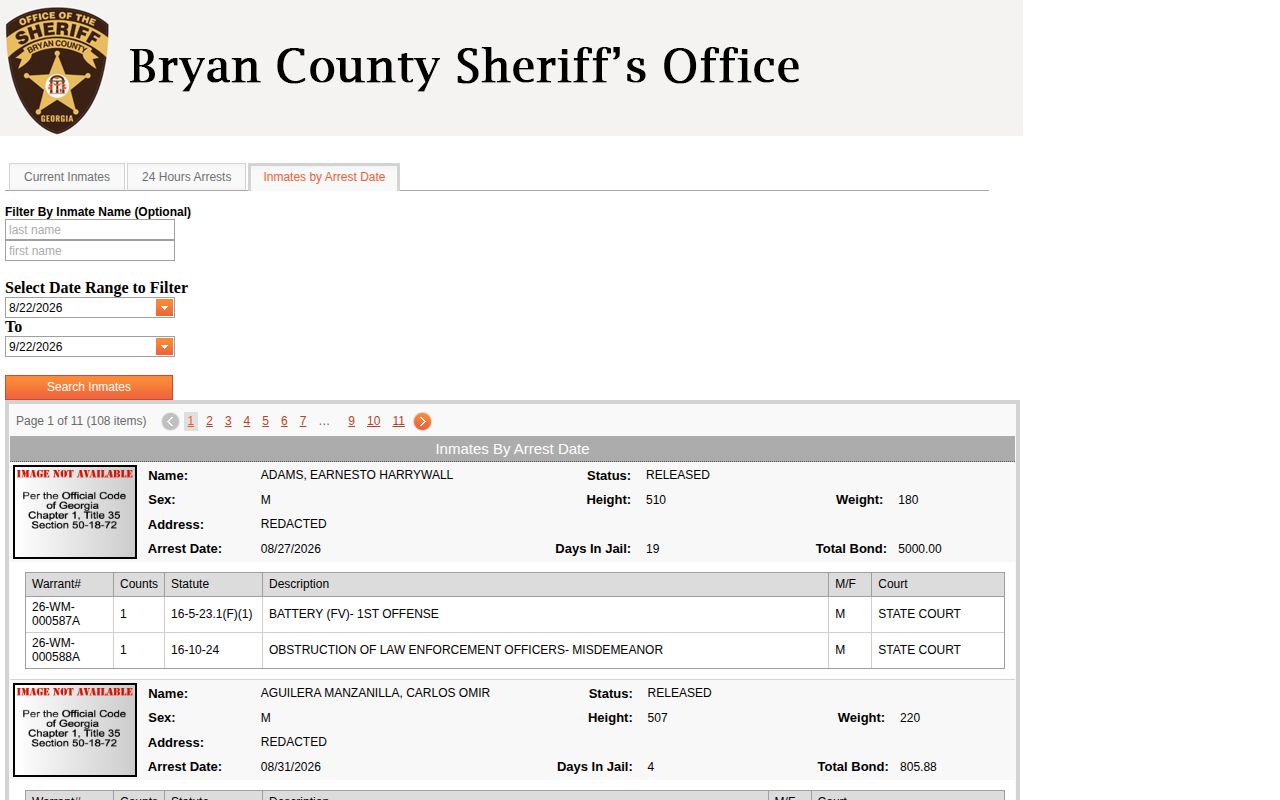
Use the county's current vendor link first; if the dates fail, ask the custodian whether a records request is needed.
Georgia Patrol Releases Are Event-Driven
The Georgia State Patrol sits inside the Department of Public Safety. Its arrest material is not a daily booking blotter. The official DPS press release index carries selected announcements about arrests, pursuits, crashes, and enforcement. Campaign summaries report activity across a named event span. None of it lists every person a trooper arrested.
GSP runs nine geographic troops and 52 posts. The agency posts no public daily arrest or dispatch log. Its post-blotter policy describes permanent station activity records rather than a live web feed. For a named person, look further. The booking record normally sits with the county or local facility that received them. And a missing DPS release never proves that no arrest happened.
Georgia News Blotters Are Secondary
News outlets add context. They do not replace a sheriff, jail, court, or records custodian. Georgia Recorder covers justice, courts, policing, and records policy. It is not a booking database. County papers and weekly jailbook columns can still be useful local leads. Every publisher chooses which cases to cover and when.
The Georgia Gazette publishes statewide arrest news and county sections. It stays secondary to the booking agency. Metro and regional outlets join in too. The Atlanta Journal-Constitution, 11Alive, WALB, and WTOC all report on arrest or court events. Stories can skip a booking, lean on initial charge language, or get updated after publication.
Check the article date and attribution against the agency record. The court record governs anything that comes later. An editorial correction route never changes the official record.
Note: News summaries may omit later charges, dismissals, or corrections recorded by the court or custodian.
Weekend Arrest Report Timing
Georgia counties follow no statewide blotter schedule. Intake continues around the clock, while a website may only refresh in batches. A newspaper column might run on a weekday, and a holiday enforcement release can lag days behind the event itself. Vendor processing and county review add their own delays.
A fresh booking may not show up yet. Meanwhile a multi-day query can return people no longer in custody. Read the date field and the custody field separately, and note the source date whenever a busy period muddies the picture.
How to Read a Georgia Blotter
Begin with the county, the source type, and the date span. The Directory can connect you to the local agency when needed. A headline or roster row is never a final case outcome.
- Confirm the source. Follow the current county or sheriff link.
- Set dates carefully. Check whether the field means arrest date or booking date.
- Compare identifiers. Read the booking number, agency, facility, and status when shown.
- Check the scope. A blotter may omit some events or later corrections.
- Ask for a record. Contact the custodian about a missing or older booking; check court records for later outcomes.
With a news item, keep the publisher and date attached to the detail. The story may grow incomplete as a case changes. For the booking entry itself, the agency remains the source.
Older Georgia Arrest Records
Older arrest records live on paperwork schedules, not web pages. A county can keep a booking file long after it drops off a public search. A vendor's short online window says nothing about retention. Vendors, counties, and record series each follow different rules. Some files get destroyed under an approved schedule. Others move to a new custodian. The Georgia Archives' retention schedules hub is where the official rules start. Its local-government print schedule covers a jail booking records series. The series is LG-19-060.
The schedule lists examples, not one rule for every arrest log. Incarceration Lists, LG-19-050, are a daily list kept one year. Inmate Case Files, LG-19-054, survive ten years after release. Prisoner Hold Records, LG-19-070, stay two years after release to the requesting agency. Each term belongs to its own series. One series' term never transfers to another record. Nor is it a promise that a public web page stays online that long.
The Georgia Archives local jail-booking schedule shows how these county record series are sorted. It is a management tool. It is not a live arrest search. It also does not promise that every file is open to the public.
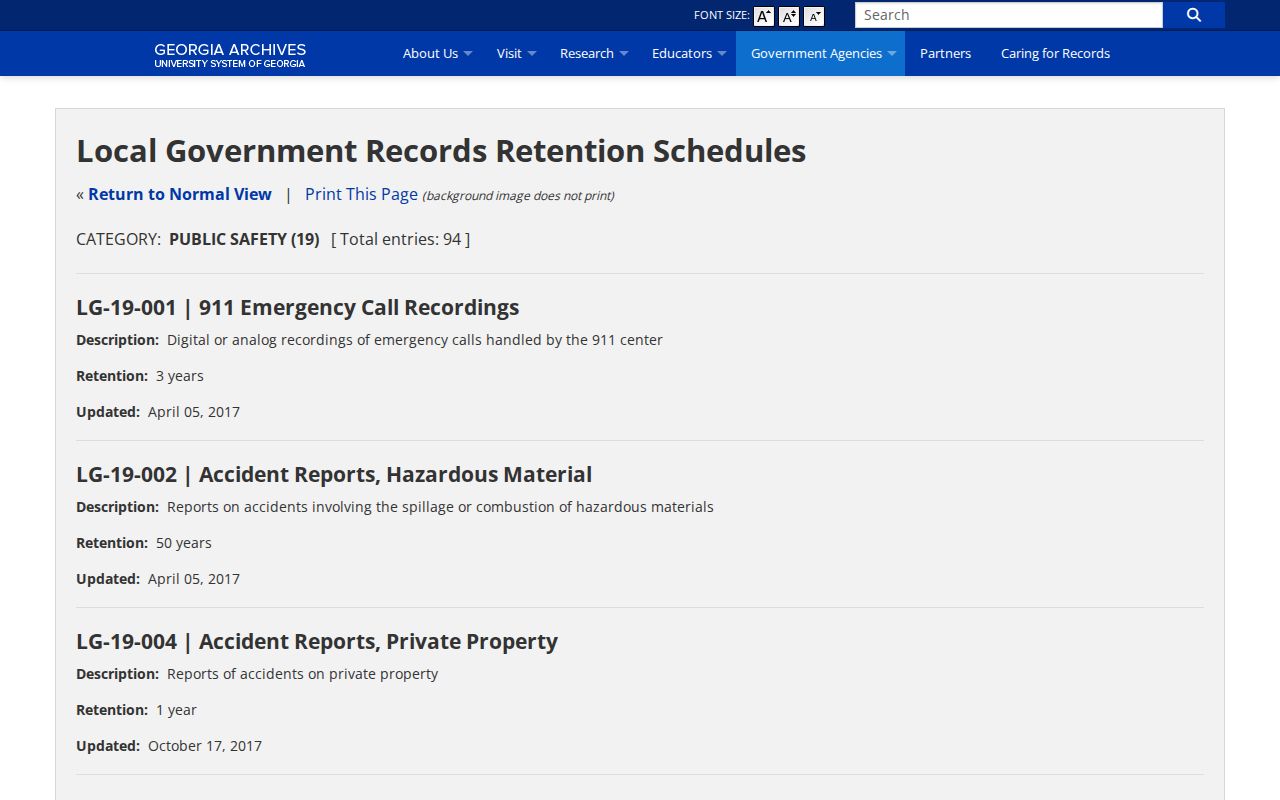
Start by pinning down who holds the older arrest record and what type it is. Then write a focused request. Name the county and facility. Give the date span and the booking record you want. Say what you want back: inspection, an electronic copy, or certification. The custodian can tell you where the record stands. It stayed local, moved, is protected, or was destroyed under schedule. The Attorney General's Georgia Open Records request guide helps here. It shows how to aim a request at the right office. Agencies do not have to build a new statewide database from scattered records.
Records sometimes move to archival custody. In that case, search the Archives catalog. Its Ask an Archivist service handles questions like this. Its research services can also pinpoint the series and the access path. Give them the agency, the county or facility, the record type, and the date span. Fees and turnaround hinge on the search and copying work involved. Confirm current terms directly rather than banking on a fixed delivery date. Historical collections are not custody feeds. They cannot show a person's present status.
Note: A schedule's retention term covers only its named series. Other records may follow an entirely different rule.
Broken Links Limit Arrest Archives
Vendor changes break pages in two ways. An older date-range page goes dead while a same-day tab simply vanishes. Old routes for Bulloch, Clarke, and Twiggs have returned errors or redirects. Catoosa and Dodge show similar changes. Those failures limit access, not the records themselves. A live page is never a complete archive. A saved copy can miss a later correction, release, or disposition.
When a saved link fails, go back to the county's current government site. Ask whether a replacement portal exists. For an older booking entry, ask the custodian. Did the record stay local, move, or get restricted? A broken page, a destroyed record, and a protected record are three different things. Archives work best for historical material once you know the series. An old booking is not a current custody check and will not reveal wanted status.